One generated image with three to six of your growth mindset points and the example phrases or behaviors you provide. At least one example is required; points without one stay on their own. Name the audience, supply any source yourself and proofread the result.
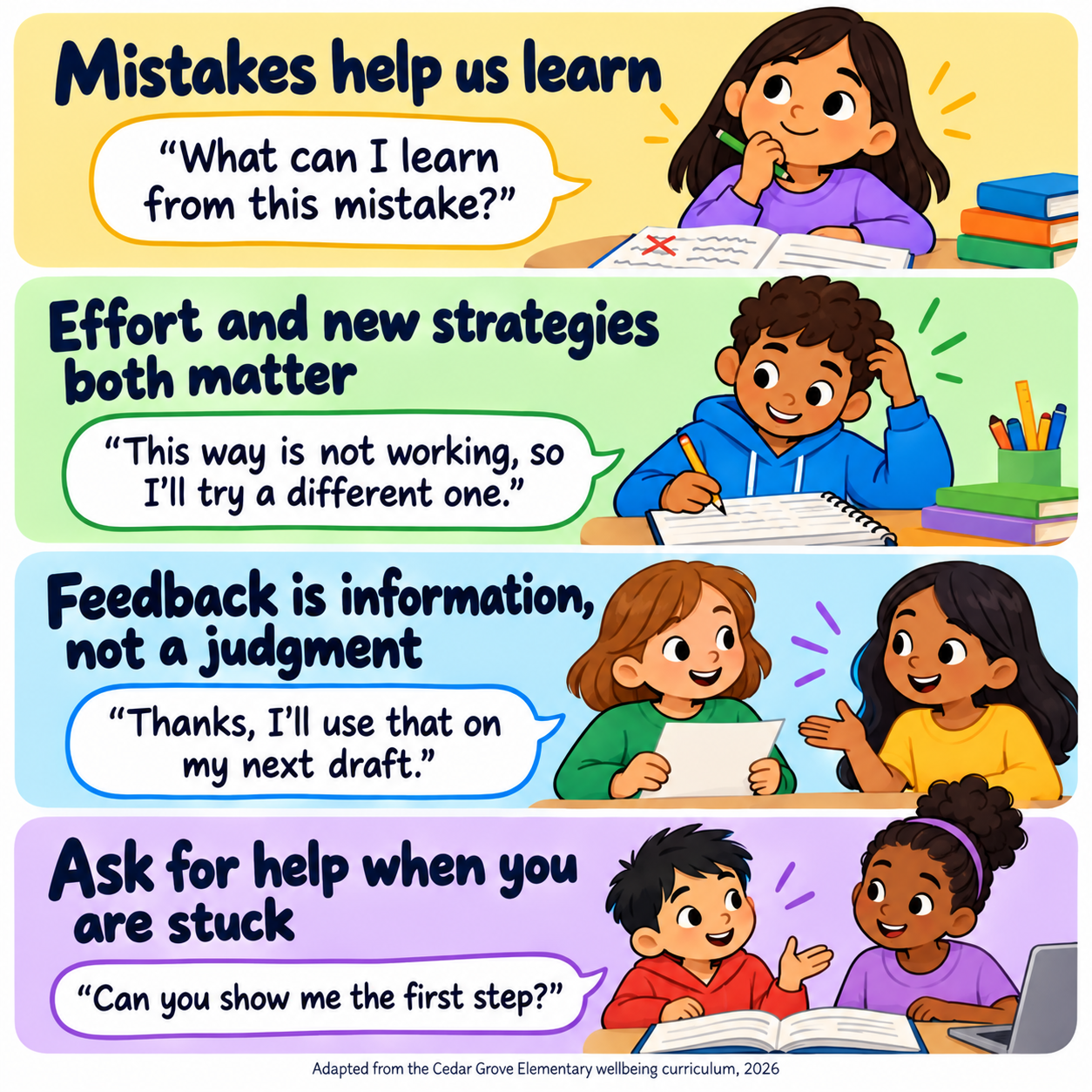
Four point-and-phrase pairs for a Grade 4 classroom
Your growth mindset points, one per line
Mistakes help us learn
Effort and new strategies both matter
Feedback is information, not a judgment
Ask for help when you are stuck
Example phrases or behaviors, in point order (at least one)
"What can I learn from this mistake?"
"This way is not working, so I'll try a different one."
"Thanks, I'll use that on my next draft."
"Can you show me the first step?"
Audience
Grade 4 students at Cedar Grove Elementary
Source for your points (optional)
Adapted from the Cedar Grove Elementary wellbeing curriculum, 2026
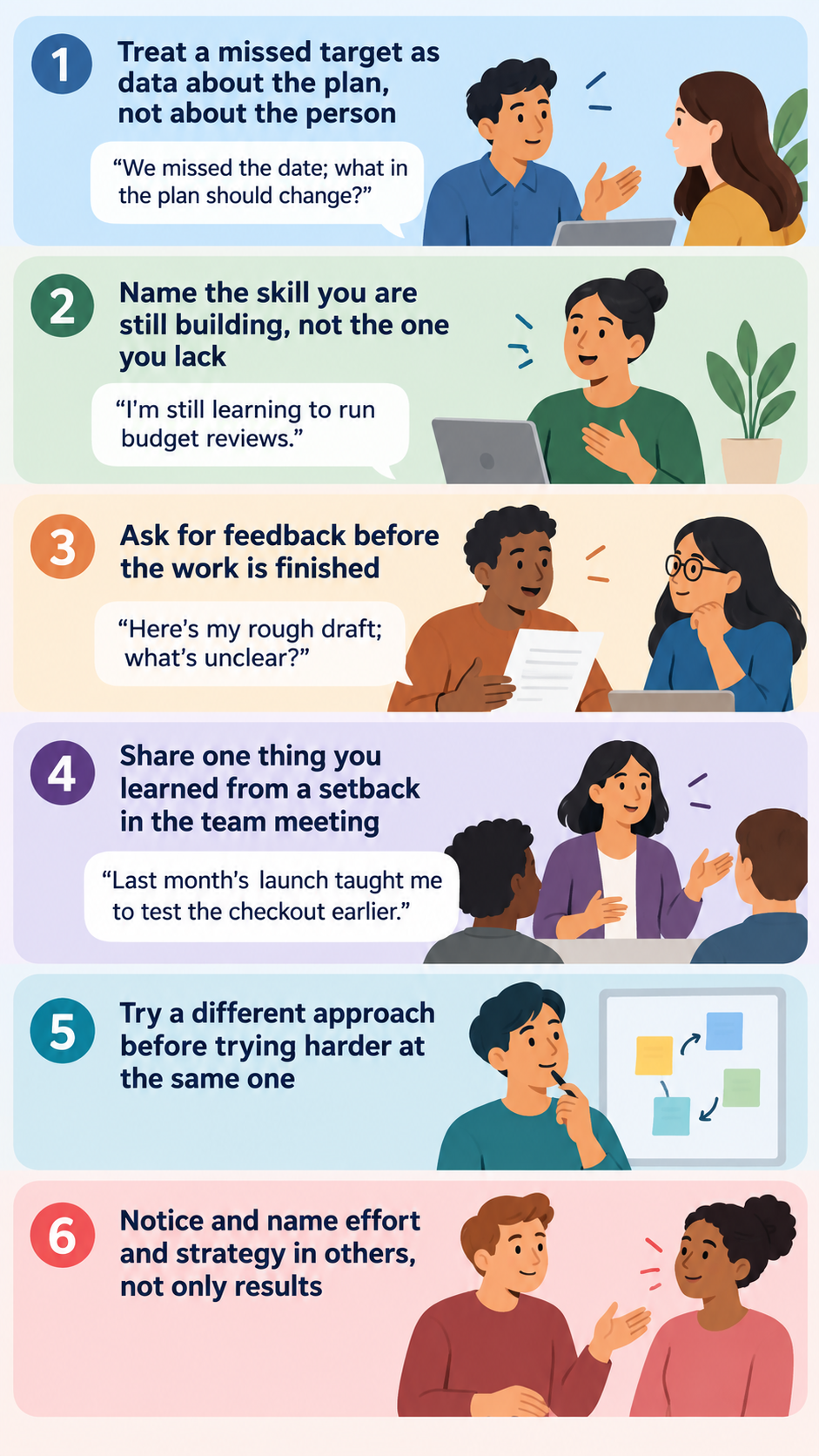
Six points for adults, only four examples and no source
Your growth mindset points, one per line
Treat a missed target as data about the plan, not about the person
Name the skill you are still building, not the one you lack
Ask for feedback before the work is finished
Share one thing you learned from a setback in the team meeting
Try a different approach before trying harder at the same one
Notice and name effort and strategy in others, not only results
Example phrases or behaviors, in point order (at least one)
"We missed the date; what in the plan should change?"
"I'm still learning to run budget reviews."
"Here's my rough draft; what's unclear?"
"Last month's launch taught me to test the checkout earlier."
Audience
New managers in the Brightwell Home Goods leadership program
Source for your points (optional)
Left empty
Six long points for an adult audience, two fewer examples than points and no source. Checks the tone shifts for adults, the unmatched points get no invented example, and no research claim or attribution appears.
Same task, three directions
Pick a direction to start from.
01
Point and phrase rows
Each point gets a row, with its supplied example beside it when available. Points without examples stand alone.
02
Climbing steps
Pairs sit on rising steps with a simple figure climbing, to suggest progress over time.
03
Quiet wall card
A minimal card for an office, coaching room or staff room, with lots of white space.
What the template keeps
The parts that stay consistent.
01
Point and example together
Each supplied example stays with its point. A point without an example gets no invented phrase.
02
Style that fits the audience
The look changes with the audience while your words stay the same.
03
Claims only with a source
Nothing presented as research appears unless you supply it and its source.
How to use it
From details to a result.
01
Write your points
One point per line in your own words, or in the wording your curriculum or program uses.
02
Add the examples you have
Give at least one phrase or behavior in point order. Keep a blank line for a missing example in the middle; trailing points may have no example.
03
Name the audience
Young children, teenagers or adults. It sets the style, not the wording.
04
Review, generate and proofread
Nothing is generated until you press Send in Vizify. Proofread every line afterwards, especially for young readers.
Output boundaries
What to check before you use it.
Points and phrases are image text and can contain spelling errors. Proofread, especially when the readers are learning to read.
Use three to six points and at least one example. Missing examples are left out; a longer program needs several images or a handout.
No research findings, brain facts or statistics are added. If you want to cite research, supply the wording and source yourself.
You get one image per request. Square and portrait are framing directions, not exact pixel sizes.
The selected ratio guides composition. Check the actual image dimensions and print readability; no exact pixels, PDF, bleed, layers or editable chart are promised.
QuestionsCan I make a growth mindset infographic for adults as well as students?+
Yes. Set the audience to your team or program and the style becomes more restrained. Your points and examples stay exactly as you wrote them.
Does it add research findings or claims about the brain?+
Claims about the brain or research findings need a source. Add the exact wording and source yourself if your curriculum includes them; the template will not add them on its own.
Can students write the points themselves?+
Yes. Collecting phrases from the class and turning them into one image is a good activity. Check the spelling before generating, since the text is drawn as written.
What if I only have examples for some points?+
Provide at least one example. Lines match points by position: keep a blank line if a middle point has none. Any remaining points appear without examples; the template does not invent them.