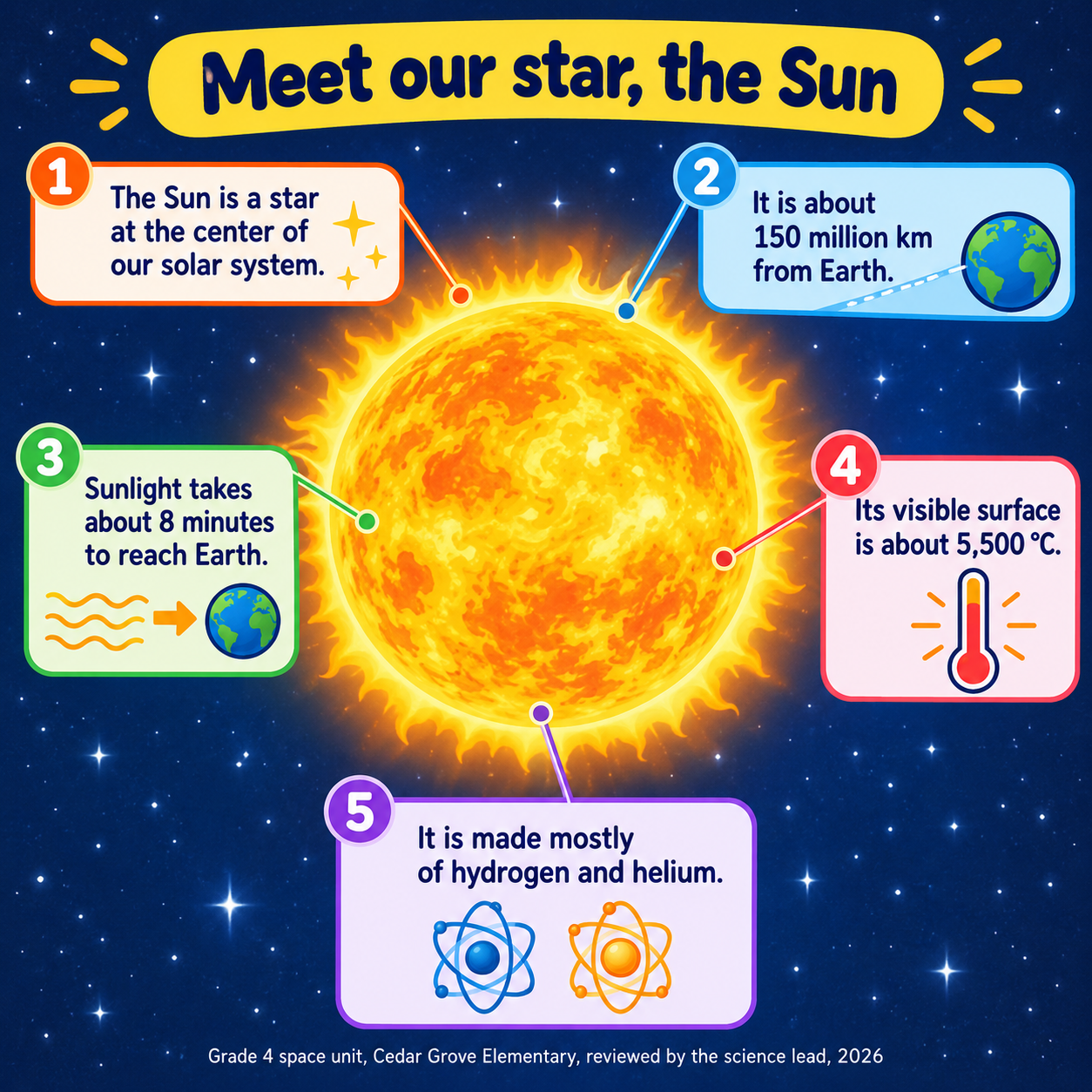
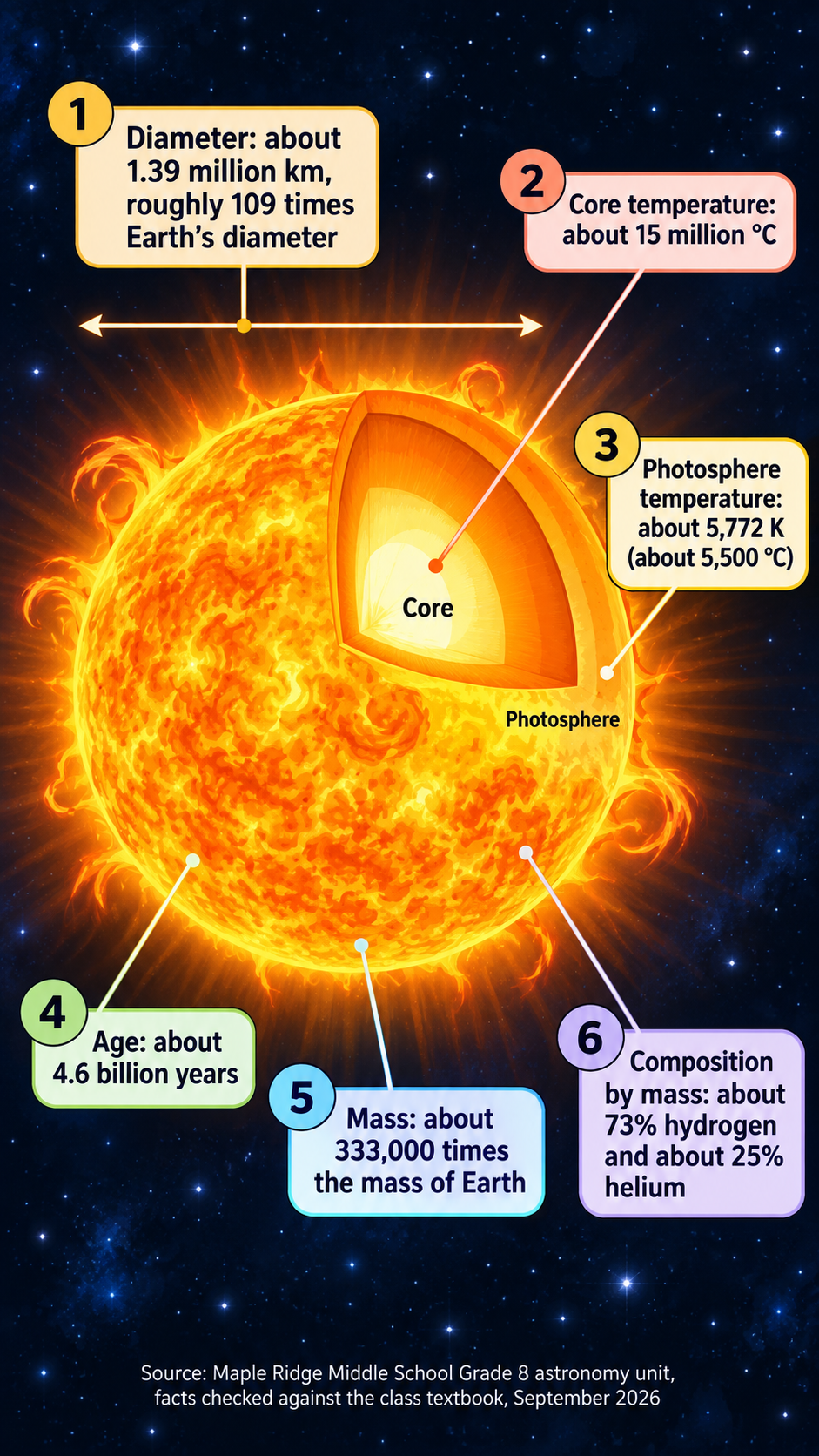
One generated illustration of the Sun with your approved facts as numbered callouts and your source as a footnote. The Sun is drawn as an explanatory illustration, not an observation photo. Check every number, unit and qualifier.
Five approved Sun facts for Grade 4 with a friendly title
Approved facts, one per line
The Sun is a star at the center of our solar system
It is about 150 million km from Earth
Sunlight takes about 8 minutes to reach Earth
Its visible surface is about 5,500 °C
It is made mostly of hydrogen and helium
Source and date
Grade 4 space unit, Cedar Grove Elementary, reviewed by the science lead, 2026
Six dense facts with kelvin and Celsius, large numbers and no title
Approved facts, one per line
Diameter: about 1.39 million km, roughly 109 times Earth's diameter
Core temperature: about 15 million °C
Photosphere temperature: about 5,772 K (about 5,500 °C)
Age: about 4.6 billion years
Mass: about 333,000 times the mass of Earth
Composition by mass: about 73% hydrogen and about 25% helium
Source and date
Maple Ridge Middle School Grade 8 astronomy unit, facts checked against the class textbook, September 2026
Grade or age group
Grade 8 earth and space science
Title (optional)
Left empty
Six dense facts with kelvin and Celsius, large numbers, percentages and "about" qualifiers, and no title. Checks units and qualifiers survive, the cutaway labels only the core and photosphere, and no extra facts appear.
Same task, three directions
Pick a direction to start from.
01
Callout diagram
A large stylized Sun on a dark background with numbered callout lines to each fact.
02
Simple cutaway
A slice of the Sun showing only the layers your facts name, with the other facts in a side panel.
03
Class wall fact cards
A friendly cartoon Sun above a grid of fact cards in large type for younger readers.
What the template keeps
The parts that stay consistent.
01
Facts as supplied
Every figure keeps its unit and qualifier, so the image does not claim more precision than your source.
02
Illustration, clearly
The Sun is drawn as an explanatory graphic that no one would mistake for a telescope photo.
03
Source on the image
The footnote travels with the image wherever it is shared.
How to use it
From details to a result.
01
Copy facts from your source
One fact per line, with the units and words like about exactly as your source gives them.
02
Add the source and grade
Name where the facts come from, and the grade that sets the type size and style.
03
Add a title if you want one
Optional. Without one, the image is titled The Sun.
04
Review, generate and check
Read the brief in Vizify, then send it. Check every number and unit on the result before it goes in front of the class.
Output boundaries
What to check before you use it.
The Sun is an explanatory illustration, not an observation photo, and sizes in the drawing are not to scale.
Every number, unit and qualifier comes from your source and is drawn by an image model. Check each one before sharing with students.
The template adds no facts, layers or comparisons you did not supply.
Three to six facts fit legibly. A full unit belongs in several images or a worksheet, and measured data belongs in a chart.
One image comes back per request, framed to the aspect ratio you pick rather than an exact pixel size.
QuestionsWhere should the facts for a sun infographic come from?+
From your textbook, curriculum or another source your school accepts. Sources round figures differently, so copy the values your class uses. The template does not look anything up.
Can it show the layers of the Sun?+
Yes, the layers your facts mention. Name the core, photosphere or corona in a fact and the callout can point to a simple labeled cutaway of that layer.
Is the Sun in the image a real photo?+
No. It is an illustration made to explain the facts. Real solar images come from observatories and space agencies, and this image does not imitate them.
Can I use Fahrenheit or miles?+
Yes. Write each fact with the units you want, and they are kept exactly as typed. Nothing is converted.