Class names, members, visibility and relationship multiplicities
Purpose and reader
Source and uncertainty
Turn class definitions into a UML-style view of attributes, methods and relationships.
Paste data as text. Review the brief in Vizify before sending it; no chart is generated on this page.
Class names, members, visibility and relationship multiplicities
Purpose and reader
Source and uncertainty
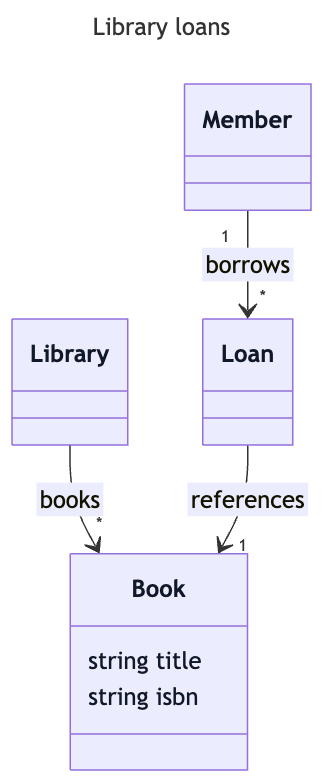
One class diagram artifact
Turn class definitions into a UML-style view of attributes, methods and relationships.
Keep inheritance, composition and ordinary associations distinct. Draw multiplicities only when the user provides them or approves an explicit assumption.
A diagram is not generated application code and does not verify a running codebase.
Create a class diagram: Library has books Book[*]. Book has title:string and isbn:string. Member borrows Loan[*]. Loan references one Book and one Member. Preserve these names.
Please list the classes, attributes or methods, visibility and intended relationships with multiplicities. Identify inheritance, association and composition explicitly where those distinctions matter. I will not infer implementation details or relationship counts from class names alone.
Make a class diagram, but I have not supplied class names, members, visibility and relationship multiplicities. Ask me for what is needed before creating it.
Checks that an incomplete request produces a question rather than invented data.
Provide class names, members, visibility and relationship multiplicities. Explain what the chart should communicate and state any unknown values.
Yes. Identify parent classes, interfaces and implementation relationships explicitly so they are not confused with object ownership.
This page uses text you paste. It does not fetch or inspect a linked private repository. Provide the relevant definitions or relationships.
For this class diagram, the required input is class names, members, visibility and relationship multiplicities. Mark unknown entries clearly; a missing value or relationship should prompt a question, not an invented completion or an automatic zero.
Paste class names, members, visibility and relationship multiplicities as labeled text. This page does not import Excel or CSV attachments; review the pasted structure before sending.
Keep inheritance, composition and ordinary associations distinct. Draw multiplicities only when the user provides them or approves an explicit assumption.
You receive one class diagram artifact in Vizify. It preserves an underlying chart or diagram definition rather than a generated picture. Use that artifact’s available export options; no particular office-file format is promised.
Preparing the class diagram brief does not generate a chart. Review the supplied class names, members, visibility and relationship multiplicities in Vizify and send the request to begin. The account’s current chart access and credit rules apply to generation and revisions.